Why Self Tanner for Dry Skin Feels So Hard (And What Actually Works)
Self tanner for dry skin doesn't have to mean patchy elbows, streaky knees, or a fade that looks more like peeling paint than a sun-kissed glow. But let's be honest — if you've tried a standard self-tanner with dry skin, you already know the struggle.
Here are the best self-tanner formats for dry skin, at a glance:
| Format | Best For | Dry Skin Benefit |
|---|---|---|
| Tinted Tanning Water | Full body, all skin tones | Water-light, quick-dry, blends clean |
| Tanning Drops | Face and body customization | Mix with moisturizer for hydration control |
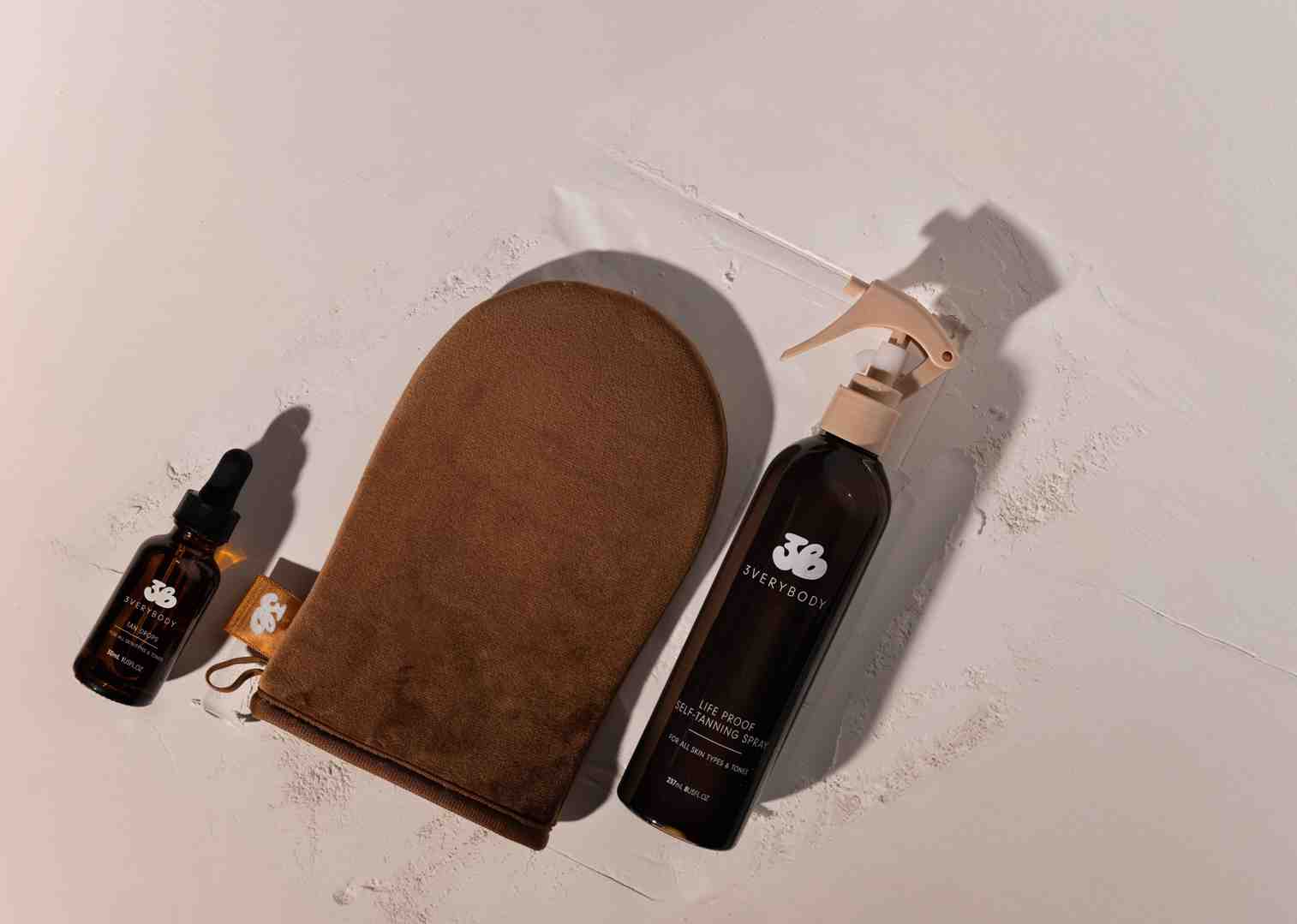
| 3VERYBODY Kit | The full routine | Includes double-sided mitt for streak-free control |
The core problem is simple: dry skin has a rough, uneven surface. DHA — the active ingredient in most self-tanners — clings to dead skin cells in dry patches. That means darker color on elbows, knees, and ankles, and faster, blotchier fading everywhere else.
The fix isn't avoiding self-tanner. It's choosing the right formula and doing a little prep.
I'm Emmy Bre, founder of 3VERYBODY and someone who spent a decade testing nearly every self tanner for dry skin on the market before building a formula I actually trusted. In this roundup, I'm sharing what genuinely works — starting with our own water-light, skin-nourishing lineup.
Basic self tanner for dry skin vocab:
Why Finding the Right Self Tanner for Dry Skin is a Different Game
When your skin is dry, it’s not just thirsty; it’s structurally different. Normal skin has a smooth, flat surface of cells. Dry skin, however, often has microscopic "peaks and valleys" where dead skin cells have begun to lift but haven't quite shed yet.
This is where the science of DHA (dihydroxyacetone) comes in. DHA is the active ingredient that reacts with the amino acids in your skin's top layer to create a tan. Because DHA is essentially "staining" dead skin cells, any area with a buildup of those cells—like a dry patch—will absorb significantly more product. This results in the dreaded "leopard spot" look.
Furthermore, dry skin tends to shed faster and more unevenly. According to Scientific research on skin cell turnover, our skin naturally sheds over a period of days, but dehydration can accelerate this process in patches. This is why a tan that looks great on Day 1 might look "cracked" by Day 4.
Safety is also a factor. While DHA is considered safe for topical use, it can sometimes be drying itself. According to a study mentioned by ABC News, there are concerns if you inhale or ingest DHA during spray sessions, which is why we always recommend applying your self tanner for dry skin using a mitt rather than standing in a cloud of mist. For a deeper dive into how moisture affects your tan, check out our dry-skin-self-tanner-guide.
How Dry Patches Affect Your Self Tanner for Dry Skin
If you’ve ever finished tanning only to find your elbows are five shades darker than your forearms, you’ve seen DHA clinging in action. Dry skin acts like a sponge. Rough elbows, scaly knees, and even the tiny lines around your knuckles are high-absorption zones.
Without proper preparation, the tanner settles into these crevices, leading to orange knuckles and uneven streaks. Because dry skin flakes off in uneven sections, the fade-out is rarely graceful. You might find your tan lasting 7 days on your stomach but only 3 days on your shins.
Choosing a Hydrating Self Tanner for Dry Skin to Prevent Flaking
The secret to a long-lasting glow on dry skin is choosing a formula that adds moisture rather than stripping it. We’ve found that water-light layers are the most effective. A thinner, water-light layer blends cleaner, dries faster, and looks natural from very fair to deep skin. This hydrating-self-tanner in a water-based format sinks in quickly and allows the skin to breathe.
This water-light approach ensures a clean blend and a natural look that works for everyone, from very fair to deep skin tones. By using a thinner layer, you avoid the heavy product buildup that often leads to flaking.
The Ultimate Prep Routine for Flawless Results
Preparation is 90% of the battle when using self tanner for dry skin. You want to create a canvas that is as smooth as possible.
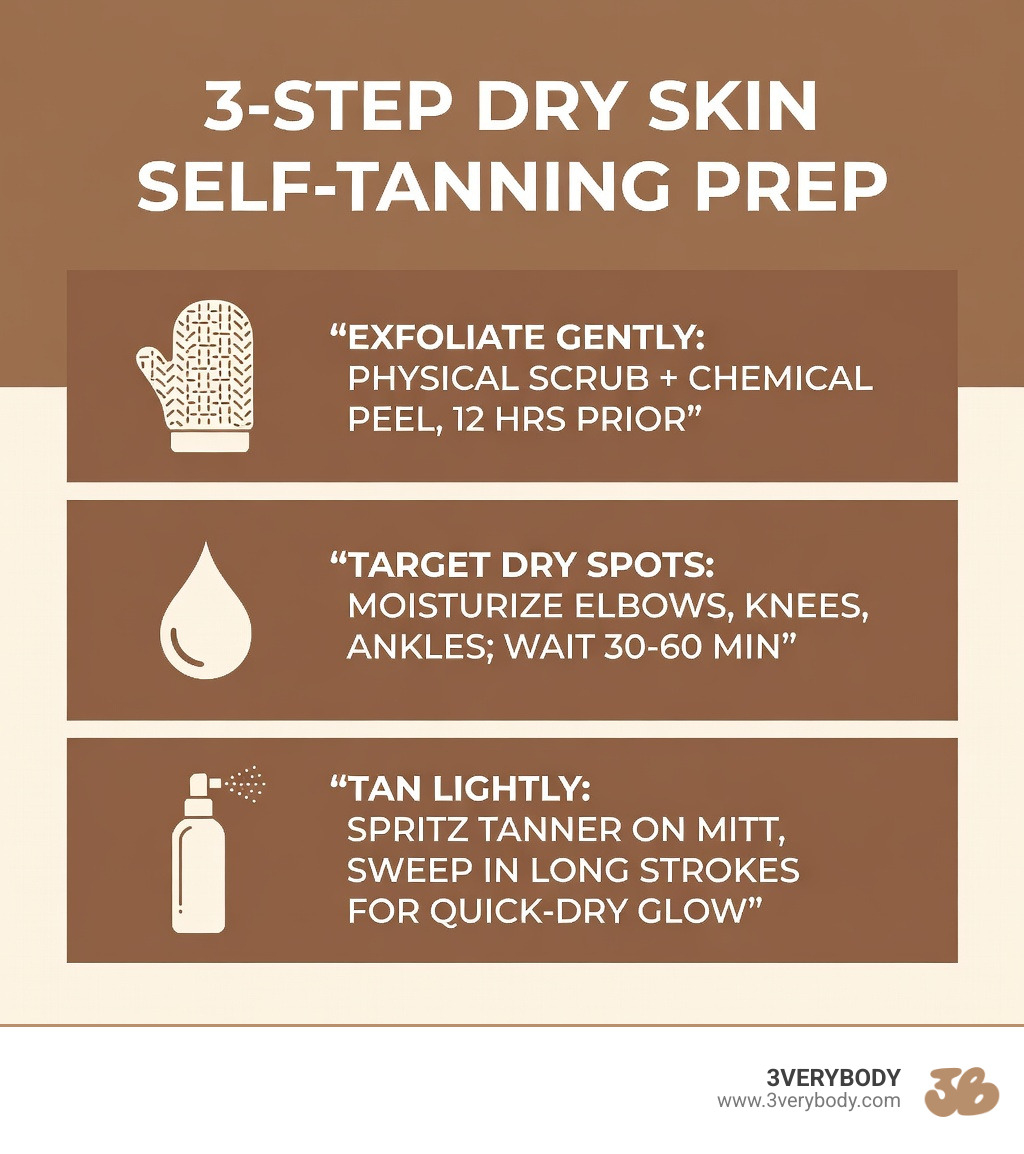
- Exfoliation (12-24 Hours Before): You need to remove those loose dead skin cells. However, don't go too hard. Rough scrubbing can irritate dry skin. Shari Marchbein, a board-certified dermatologist, suggests sloughing dead skin with an oil-free cleanser laced with glycolic or salicylic acid. This provides a chemical exfoliation that is often gentler than a gritty scrub. For more tips, see The Importance of Exfoliation in Self-Tanning Routines and our exfoliator-for-dry-skin-guide.
- Shaving and Waxing: Do this at least 24 hours before your tan. Shaving opens the pores, and if you apply tanner immediately after, you might end up with "tanned pores" (those little dark dots). Beauty experts note that all treatments like waxing or manicures should be done before the tan, as they can strip the color right off.
Moisturizing Strategies Before You Tan
There is a big debate: should you moisturize before tanning? The answer is yes, but only in specific spots.
Applying a heavy lotion all over your body right before tanning can create a barrier that prevents the DHA from reaching your skin, leading to a patchy result. Instead, focus on "spot-treating." Apply a small amount of oil-free moisturizer to your "high-absorption" areas:
- Elbows
- Knees
- Ankles and Heels
- Knuckles
- Wrists
Wait at least 30 to 60 minutes after moisturizing these spots before you start the tanning process to ensure the lotion has fully absorbed. For a full breakdown, visit should-you-moisturize-before-self-tanning or our ultimate-moisturize-self-tan-guide.
Top Ingredients to Look for in a Moisturizing Formula
When shopping for a self tanner for dry skin, the ingredient list is your best friend. You want a formula that acts like high-end skincare. Look for these powerhouses:
- Argan Oil & Rosehip Oil: These provide deep fatty acids to repair the skin barrier.
- Cucumber Oil & Extract: Incredibly cooling and hydrating for sensitive, dry types.
- Hyaluronic Acid & Squalane: These are humectants that pull moisture into the skin and lock it there.
- Caffeine & Guarana Extract: These help firm the skin’s appearance while the tan develops.
- Aloe Vera & Vitamin E: Classic healers that prevent the "itchy" feeling some tanners cause.
At 3VERYBODY, our products are vegan, cruelty-free, and strictly paraben and sulfate-free. We believe that what you put on your skin should be as clean as the glow it produces. For more on ingredient-focused tanning, check out our hydrating-self-tanner-guide-2026.
Our Top Picks: The Best Self-Tanning Products for Dry Skin
Finding the "holy grail" product depends on your routine. Here are our top recommendations:
1. 3VERYBODY Life Proof Tan (Tinted Tanning Water)
This is our flagship product. It's a water-light mist that provides an immediate "guide color" so you can see where you're applying, but it dries in seconds. It’s enriched with argan oil and caffeine, making it the ultimate self tanner for dry skin. It’s sweat-resistant, transfer-resistant (safe for your white sheets!), and never looks orange.
2. 3VERYBODY Tanning Drops
If you have a moisturizer you already love, our Tanning Drops are the perfect addition. Mix a few drops with your favorite body butter or face cream to customize your glow. They feature rosehip oil and cucumber extract to keep your skin supple.
| Feature | 3VERYBODY Life Proof Tan | Traditional Tanners |
|---|---|---|
| Drying Time | < 1 minute | 10–20 minutes |
| Feel | Water-light, non-sticky | Can feel heavy or greasy |
| Transfer | Sheet-safe / No transfer | High risk of staining |
| Hydration | Argan & Cucumber Oils | Varies |
Expert tip: Always start with your legs and work your way up, finishing with your hands to ensure the most natural distribution of color.
Application Tips for a Streak-Free Finish
To get that salon-quality result at home, follow our simple "Emmy-approved" method:
- Spritz: Spray the Tinted Tanning Water directly onto your 3VERYBODY Tanning Mitt.
- Smooth: Apply in long, sweeping strokes. Use gentle circular motions to blend the edges.
- The "Dry" Zones: Leave your hands and feet for the very last. Use only the leftover residue on the mitt for these areas, blending with the clean side of the mitt to prevent over-saturation.
- Dry & Go: Let it dry for a few minutes (it’s quick!), then throw on loose clothes.
- Rinse: After 4–8 hours, do a quick lukewarm rinse (no soap!) to reveal your glow.
Taking your time with the blending process is what separates a DIY tan from a professional-looking one.
Maintenance and Removal: Keeping Your Glow
Once you’ve achieved your perfect tan, you want it to stay. Self tanner for dry skin usually lasts between 5 to 10 days, but without maintenance, it can fade fast.
- Hydrate Daily: This is non-negotiable. Moisturizing once or twice a day is the only way to prevent the "cracked" look as the tan fades. Does it actually help? Yes. See does-moisturising-help-fake-tan-last-longer.
- Lukewarm Showers: Hot water strips the skin of its natural oils and the tan right along with it. Stick to lukewarm water and a gentle, sulfate-free body wash.
- Pat, Don't Rub: When you get out of the shower, gently pat your skin dry with a towel. Rubbing is essentially exfoliation, which will lift your color.
When it’s time to start fresh, use a dedicated tan remover or a gentle exfoliating mitt. These are great choices for breaking down old pigment without needing to scrub your skin raw.
Frequently Asked Questions about Tanning Dry Skin
Can I use body self-tanner on my face if I have dry skin?
Technically, you can, but we don't recommend it. David Kim, a board-certified dermatologist at Idriss Dermatology, explains that body tanners are often formulated with higher concentrations of oils that can be comedogenic (pore-clogging) for the face. It’s better to use face-specific Tanning Drops that you can mix with your existing facial skincare.
How long does self-tanner last on dry skin?
Typically, you can expect 5–7 days of solid color. With proper hydration, you can push that to 10 days. If your skin is extremely dry and you aren't moisturizing, it may start to look patchy by Day 4.
Are there options for eczema-prone or sensitive skin?
Yes! Look for formulas with 100% natural DHA and a balanced pH. Products designed for sensitive skin or compromised skin barriers are your best bet. Always do a patch test on a small area first.
Conclusion
At 3VERYBODY, we believe everyone deserves a confident, sun-kissed glow without the UV damage or the "spray tan stink." As a woman-owned, inclusivity-first brand, we’ve worked hard to ensure our water-light formulas work on every skin tone and type—especially those of us dealing with dryness.
Whether you’re a pro or a first-timer, our 3VERYBODY Kit has everything you need to achieve salon-quality results at home. No stickiness, no mess, and definitely no orange—just life-proof color that loves your skin back.
Ready to glow? Grab your kit and let's get started!